
Who We Are
Christ Centered
Relationship Builders
Integrity & Accountability Developers
Grace & Compassion Sharers
Hope Encouragers
-
People and communities restored to wholeness — flourishing in faith, relationship, and circumstance as God intended; free from the cycles that once held them back.
-
Instilling hope in Christ's name, we walk alongside our neighbors as advocates, relationship-builders, and connectors — collaborating to clear hurdles, not just symptoms, so people flourish, not just cope.
-
Advocate: Standing WITH people, not just FOR them.
Resource Navigator: Knowing where help lives and how to access it.
Collaborator: Partnering with others so more than just symptoms are addressed.
Relationship-Builder: The soil from which the other three pillars grow — because advocacy, navigation, and collaboration only take root in the context of real, trusted relationship.
Our History
Thirty years ago, three Christian churches on the east side of Noble County saw a need their walls could not contain. Neighbors were struggling, resources were thin, and families were quietly slipping through the cracks — sometimes receiving help from multiple churches for the same needwithout anyone knowing. Rather than compete, those churches chose to collaborate. On September 20, 1996, Common Grace was born.
What began as a shared effort to meet immediate needs has become something far richer: a thirty-year journey of learning, humility, and transformation — from an organization that helped people survive, to one that walks alongside neighbors as they learn to flourish.
This is not just a history of what we’ve done. It’s a story of how God has changed us.

The Foundation (1996–2012)
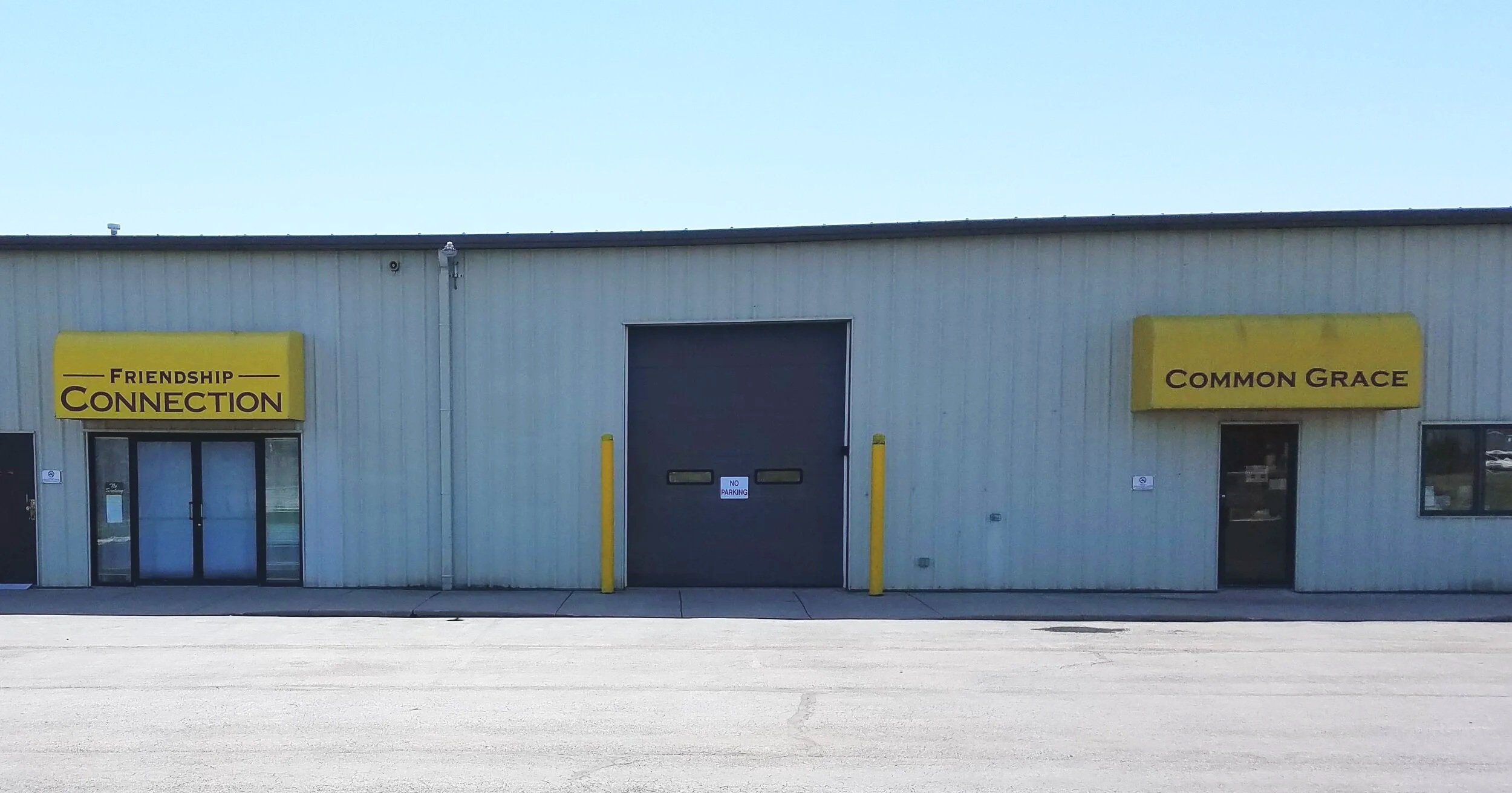
Common Grace established offices in Kendallville, Albion, and Ligonier, and began sponsoring the Friendship Food Pantry. A Hope Chest (then called Furnishings of Faith) offered household goods when space allowed. The early years were marked by a simple, urgent calling: see a need, meet a need.
These were faithful years. The churches of Noble County showed up for their neighbors — and that spirit of showing up has never left us.
Growing Pains and a New Direction (2013–2015)
By 2013, it was clear that growth required structure. With the support of a generous private donor, Common Grace engaged a consultant and formally reorganized. The organization became Common Grace Ministries, Inc., with Friendship Food Pantry and A Hope Chest operating as ministry divisions. Furnishings of Faith was renamed A Hope Chest — giving the three ministries a unified sense of identity: Friendship, Hope, and Grace.
In 2016, Friendship Food Pantry became Friendship Connection — a name that pointed toward something larger than food distribution. The word "connection" was intentional. We were beginning to see that what our neighbors needed most wasn't just a bag of groceries. They needed someone who knew them by name.
The Turning Point: Learning to Help Without Hurting (2016)
In August 2016, a difficult truth surfaced: Friendship Connection had been serving the same families for four generations. Without meaning to, Common Grace Ministries had been sustaining cycles of poverty rather than helping break them.
It was a hard realization. But it was the most important one we've ever had.
Staff and board members began reading deeply — Toxic Charity, Charity Detox, When Helping Hurts, and more. They learned that poverty is not primarily about "stuff," and that giving people free things without relationship, dignity, or accountability was not generosity — it was, at best, a Band-Aid, and at worst, a harm.
The team made a decision: Common Grace Ministries would become a place that helps without hurting. That meant building real relationships with every neighbor who walked through the door. It meant replacing one-way handouts with two-way partnerships. It meant believing — genuinely believing — that every neighbor carries talents, abilities, gifts, and skills that our community needs.
This is not an easier way of doing ministry. But it is most certainly a better one.
Putting Principles Into Practice
The shift showed up in every ministry:
At Common Grace, the Where Does Your Money Go program was introduced — a financial literacy conversation engaged in by every neighbor requesting assistance. Many had never worked with a budget before. Connectors began helping neighbors identify "money leaks" and distinguish wants from needs. Neighbors were often asked to pay a portion of their own bill or complete a task toward economic health before assistance was provided — not as a barrier, but as a first step toward agency.
At A Hope Chest, a small processing and delivery fee was implemented. The result surprised no one who understood human dignity: not one neighbor complained. People were glad to provide for their families without receiving a handout.
At Friendship Connection, policies were tightened around service area, identity verification, and shopping hours — not to make things harder, but to make the ministry sustainable and dignified for everyone. The result was striking: participation among neighbors 60 and older rose 9.54%. Seniors who had felt unsafe in crowded lines began returning. Some became volunteers. And the amount of food each neighbor received increased from an average of 8 pounds to 20–35 pounds per person.
Fresh produce was added through a neighbor-led garden. Heart-healthy, diabetic-friendly, and gluten-free sections were introduced. A neighbor newsletter covering physical, spiritual, mental, and economic health topics was launched in 2022.
From Teaching to Fish to Cleaning the Pond
We all know the old saying: give a person a fish, or teach them to fish. For years, Common Grace taught people to fish. But we began asking a harder question: What if the pond is toxic?
If we help a neighbor budget their money but send them back to a domestic violence situation — what have we actually accomplished? If we teach financial literacy but ignore the housing crisis, the mental health crisis, the transportation gap — are we really helping people flourish?
In 2022, we turned our attention to the toxic ponds. We went deeper into our founding pillar of advocacy — not just meeting individual needs, but working to clear the systemic hurdles that keep our neighbors stuck.
Domestic Violence: Common Grace joined the Noble County DV Task Force to recognize signs and respond more effectively.
Housing: CGM initiated conversations with Brightpoint about affordable housing options, joined the Noble County Housing Coalition, and became the agency selected to represent Noble County in a 3-county pilot program that brought eviction intervention clinics and a legal access kiosk to the community — in partnership with Indiana Legal Services, the Volunteer Lawyer Program, and the Noble County Court System. CGM continues to work directly with property managers and landlords to get resources into the hands of at-risk tenants to avoid eviction.
Mental Health: CGM joined the Noble County Mental Health Collaborative. CGM is part of a transportation initiative through the Mental Health Collaborative.
Reintegration Following Incarceration: Common Grace welcomed law enforcement onto its board and partnered with Noble House to create a Quick Resource Guide — now used by first responders across Noble County, printed in both English and Spanish. In 2026, CGM was invited to join the Northeast Indiana Regional Reentry Coalition.
Transportation: Through a new ministry called Getting Started, CGM is tackling the rural transportation gap one car repair at a time — connecting neighbors to trusted repair shops, towing companies, parts stores, and lending agencies so that a broken-down car doesn't mean a lost job.
Building a Community of Flourishing
Over time, the work at Common Grace grew from three churches helping neighbors to a movement of neighbors helping neighbors. In December 2016, a New Way Workshop introduced the broader community to asset-based community development — the idea that every community, and every person in it, has assets worth seeing and engaging. This led to the formation of Noble New Way, a community-led project team dedicated to spreading ABCD principles across Noble County and beyond. Noble New Way is a part of the DNA of CGM and is fully integrated into CGM.
You cannot fix a deficit with a deficit. You must use your assets to overcome deficits. And to use them, you must first be able to see them.
We are proud members of the True Charity Network, a national community of organizations committed to genuine poverty alleviation — from boots on the ground to legislative chambers. We are deeply grateful to The Chalmers Center, whose Helping Without Hurting framework and Innovate program shaped the way we design and deliver ministry.
Where We Stand Today
Thirty years in, Common Grace Ministries has grown from three ministry divisions to four, with three full-time and one part-time staff members — and a community of volunteers, donors, partners, churches, businesses, organizations, and neighbors who make it all possible.
We have updated our vision and mission to reflect who God has grown us to be:
Vision: People and communities restored to wholeness — flourishing in spirit, relationship, and circumstance as God intended; free from the cycles that once held them back.
Mission: Instilling hope in Christ's name, we walk alongside people as advocates, relationship-builders, and connectors — collaborating to clear hurdles, not just symptoms, so people flourish, not just cope.
These are not just new words. They are the hard-won language of thirty years of learning, listening, and growing. They describe what we have become — and point toward what, by God's grace, we are still becoming.
We are grateful for every prayer, every dollar, every volunteer hour, and every neighbor who has trusted us to walk alongside them. You have helped make this possible. Thank you — and to God be the glory.